Practicing the art of questioning with the wooden fellows
- Frédérique and the Wooden Fellows
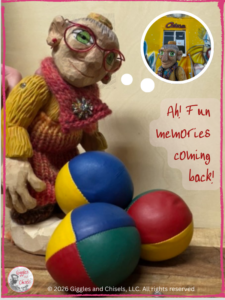
A few weeks ago, a discovery brought quite a bit of excitement to the Petit Refuge: a set of juggling balls.
I, the hand being the wooden Fellows, have a tendency to keep stuff. You never know what you be, once again, useful, right? And I am so glad I did, because it all started like this:
Mme Rigolotte: “Juggling balls! Juggling balls!”
Me: “You look so excited. What memories do they bring up?”
Haven’t met the wooden Fellows yet?
Discover who they are here and where they come from!
Have you ever wondered why some discussions are quite engaging, while others fade?

Often, it comes from a thoughtful question, asked at the perfect time. Indeed, a thoughtful question can keep us going and going, and extend our thinking. A thoughtful question can slow us down and open the door to unexpected stories, ideas, and future adventures. Hence, questioning, i.e. questioning that truly stimulates our thoughts, is an art to practice.
The wooden Fellows, being so curious and intrigued by our world, ask questions constantly. But the questions raised by their Human friend (me!) also push their thinking further, gently but intentionally. Similarly, young children who are developing their brains at full speed need a balance of freedom to explore and stimulation from “more knowledgeable” individuals, as Lev Vygotsky would refer to. However, in a world of instant responses enabled by Artificial Intelligence (AI), raising thoughtful questions may become a forgotten skill. AI will come up with “something”, focusing on the outcome rather than the progress of thinking. Asking questions is hence critical for stimulating young children’s thinking, but also for modeling how to fulfill our own curiosity as something humans do together.
For the past four weeks, we have been exploring the art of questioning with our newsletter subscribers, and now the wooden Fellows are ready to share their stories with you.
- Throughout this post, you will practice asking questions alongside them.
- By the end, you will notice how a single question can open the door to memories, observations, and even inventions when we reflect together.
First, let's assess where we are!
Before trying something new, it is helpful to notice what we already do naturally. Before talking about how we ask questions, let’s notice what questions we naturally ask.
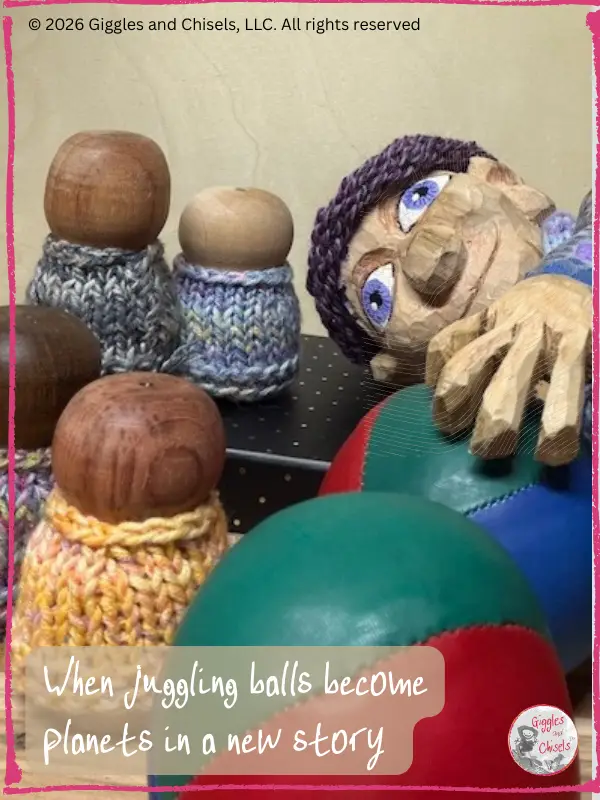
Mme Rigolotte was so excited about the set of balls that she had to share her discovery with the other wooden Fellows at the Petit Refuge.
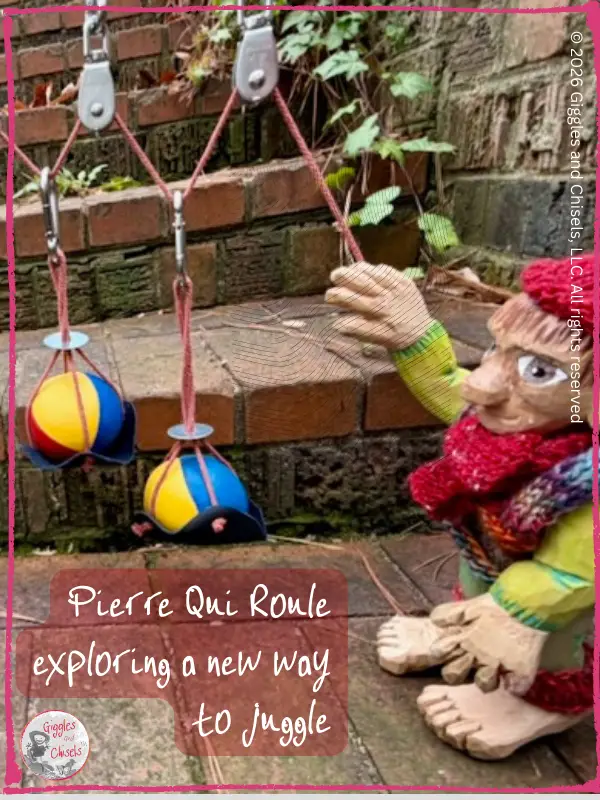
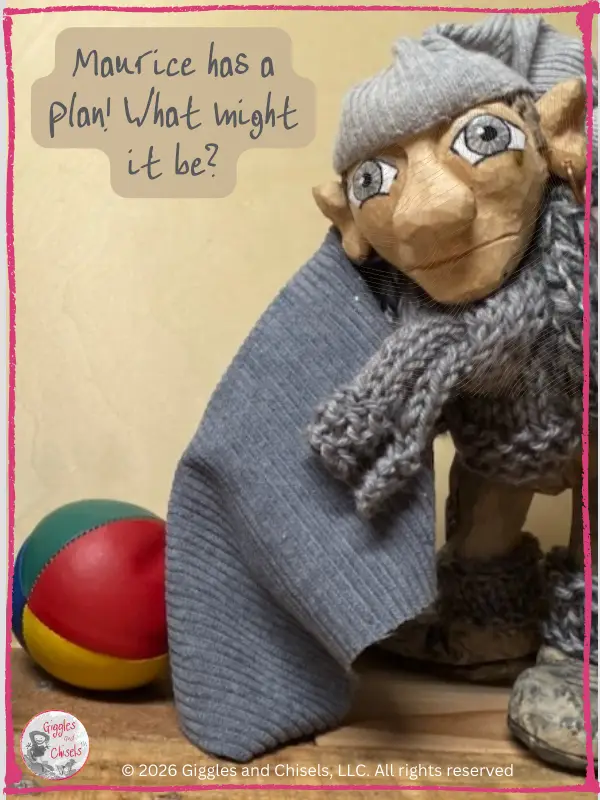
Look at the pictures of them taken shortly afterwards. Imagine you could ask them questions to better understand what they are doing. What questions would you ask them?
Are they closed-ended like “Do you like playing with balls?” or are they more open-ended like “What do you like about playing with balls?” How do those two questions feel different to answer?
Then, Let's start with three lenses of Questioning
Now imagine you are with them, as Maurice is moving around with his piece of fabric, Pierre Qui Roule looks for more pulleys, Petite Clothilde is whispering to the Bouilles. It is hard to come up with a question on the spot, isn’t it?
As an early childhood educator, I found it helpful to start thinking about questions through three different lenses to support thinking and curiosity. For other educators out there, it fully aligns with Bloom’s taxonomy (will come back to it at the end of the post), just simplified a bit. I talk about lenses, instead of questions, to include statements like “tell me more about…” which is one of my favorite prompts to use with young children.
First, take a lens of Looking Back, i.e., questions drawing on memory and experience.
One of the reasons Mme Rigolotte was so excited about finding those juggling balls was that they brought her back memories of going to the circus for the first time, when she visited France with the Human Friend. She still remembers the joyful music, the bright lights, the giggles in the audience, and even the smell of popcorn mid-show.
Such context easily opens the door to a first level of thinking and questioning through the lens of Looking Back. Through this lens come questions stimulating Mme Rigolotte’s experiences with the circus and memories around circus-related vocabulary.
“You look so excited. What memories do they bring up?”
Second, a lens of Looking Closely (or Here), i.e., questions focusing on what is happening right now.
Maurice, too, went to the circus in France with Mme Rigolotte, and he, too, remembered the lights and the music, but mostly because they quickly brought a feeling of overwhelmingness. So when Mme Rigolotte shared her discovery, he dug into our pile of fabrics and found the perfect piece to create his own set of juggling balls, just less colorful than the initial set (well, he was hoping I, his Human Friend, may be up to the challenge).
This opens the door not only to Looking Back, but also to Looking Here (or Looking Closely), focusing on the moment.
“Maurice, tell me about the fabric you found? Why did you choose those colors?
Later in the day, all was quiet in the Petit Refuge, until we could hear Petite Clothilde whispering a new story to the Bouilles, using the juggling balls as… planets. The Bouilles were captivated, and so were the other wooden Fellows, as Petite Clothilde included bits of her own world, the Land of the Smooths and Mellows. Shades of blues and purples, puffy clouds, and Doudoux-Tout-Doux, the inhabitants, all around.
This offers another example of focusing on the moment, to extend what is going on right now, without rushing.
“Tell me more about the planets and the characters in your story!”
It also emphasizes the fluidity between lenses, as questions can prompt Petite Clothilde to recall past memories from the Land she came from.
“When you lived in the Land of Smooth and Mellows, what was your favorite food to eat as a Doudou Tout Doux?”
Last, a lens of Looking Beyond, i.e., questions that invite imagining, extending, or designing.
Pierre Qui Roule was quite curious about juggling, but became a little frustrated after a few tries. He decided to invent his own way of juggling by going outside and using pulleys, opening the door to our third level of thinking, Looking Beyond, with opportunities to extend his thinking.
“What happens if you add a pulley?
What else could you use a pulley for?
Again, this emphasizes the fluidity of lenses, as a question like “Tell me about what you are creating” would focus more on what happens now.
Similarly with Maurice, prompting him with how he is planning to create a new set of ball, regarding size and number, for instance, would extend his thinking further.
Balancing lenses at the perfect time
Once you become aware of those various levels of thinking required by questions, you become aware of the questions that come naturally to you and keep your focus on the ones that do not, so you can, throughout any conversation, offer a balance of questions. As mentioned in the introduction, we also refer to the “perfect time” to ask a question. The goal is not to interrupt someone’s play, or someone’s flow; it is just about adding on to extend the conversation and extend the thinking of everyone.
When Petite Clothilde is telling a story, it is important to gauge if she expects you to listen or to participate. You may have to pause your questions to respect her imagination. No magic tricks here; the art of questioning comes with practice, slowing down, and understanding the person you are interacting with.
Now is time to put our learning into practice!
At the Petit Refuge, we believe in learning by doing and practicing (and playing!), so let’s take some examples to support the exploration of those three lenses.
A good way to start practicing questioning is to look at old pictures so you can think about them ahead of time before engaging young children (or adults!) in deeper discussions. Do you ever take pictures just to discuss later on with a loved one who is absent at that moment?
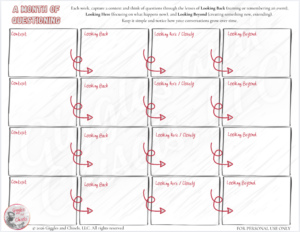
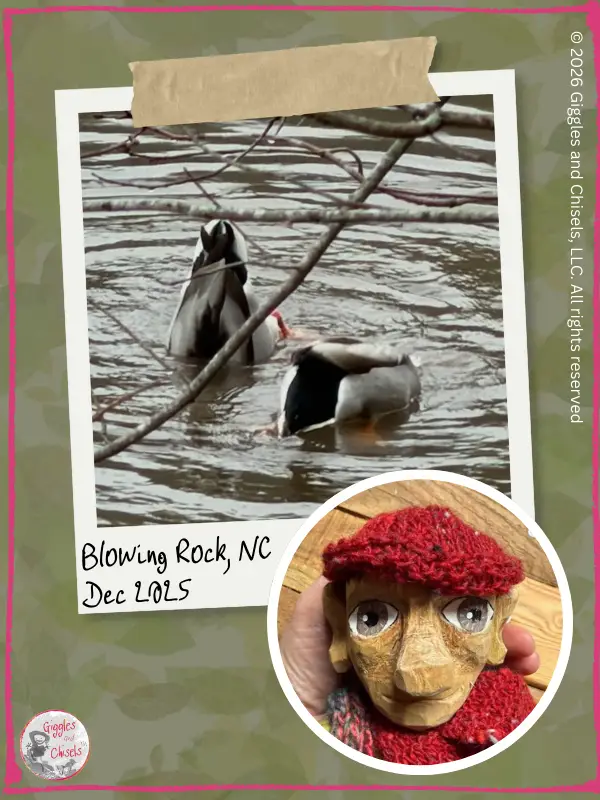
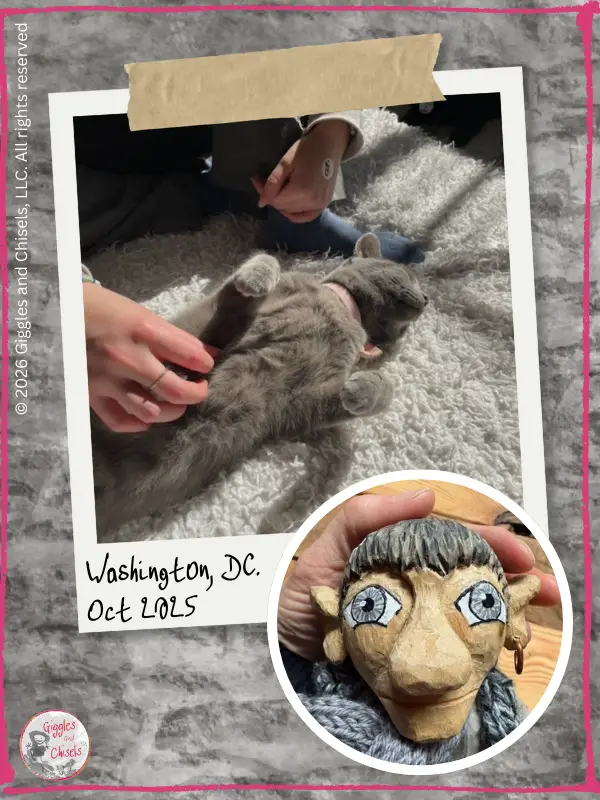
We are sharing four pictures of the wooden Fellows, and a free questioning template as a PDF.
- You can use it along the way, as we invite you to imagine a moment with the Fellows, and try a question from each lens.
- You can use it later on with your own contexts and see where the curiosity takes you.
There is no right way to do it.
You are welcome to share your questions in the comments, the wooden Fellows are always listening and happy to answer back to any curious humans : )
Ready to go deeper?
Once you feel comfortable playing with the three lenses—Looking Back, Looking Closely, and Looking Beyond—you may notice that your questions naturally deepen.
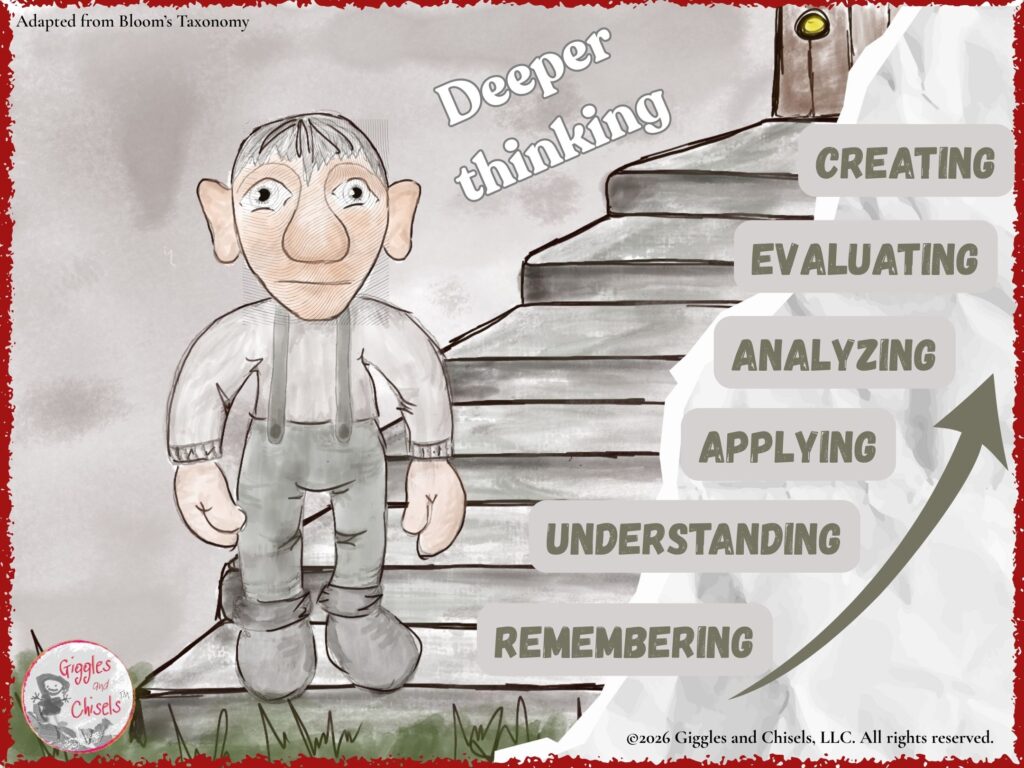
This is where you can fully embrace Bloom’s Taxonomy, and its levels of thinking. A book like Big Questions for Young Minds, by Strasser and Mufson Bresson, also grounded in Bloom’s Taxonomy, offers a beautiful way to explore these layers of thinking with young children. We discussed their approach in a previous post, drawing from daily Instagram photos as prompts for reflection and conversation. Much like our three lenses, but with added nuance, the authors describe a way of questioning that unfolds gradually, growing alongside children’s experiences.
–> read our previous post How to Ask Questions to Stimulate Thinking Further: A Quick Practice With the Wooden Fellows
At the most basic level, questions help children remember facts, names of objects, or words. As complexity increases, questions invite children to understand and describe a context. Further along, questions encourage children to apply ideas and explain their reasoning. The next level prompts children to analyze ideas by comparing and contrasting thoughts. Then, questions may invite children to evaluate a situation or express an opinion. Finally, at the highest level of thinking, questions open the door to creating or designing something on their own.
In that way, the progression of questions mirrors both Bloom’s levels of thinking and the natural flow between Looking Back, Looking Closely, and Looking Beyond. But with our practice with the wooden Fellows, it suddenly feels more reachable to add layers to your art of questioning, doesn’t it?
Your Homework before we wrap up!
We also believe in learning by practicing : )
1 – We invite you for a few days to choose a simple moment, a living situation, a photo, a story being told. Take a minute to slow down, and come up with questions through each lens:
- Looking Back: What past experience could this connect to?
- Looking Closely: What is happening right now? What do I notice if I slow down?
- Looking Beyond: What might happen next? What could this become?
You can use the template shared previously to keep track of your notes, or find your own system.
You are going to notice that you may easily find questions at each level. Sometimes, you may feel like one is enough.
There is no right or wrong way to do this, it is the process that counts. We are sharing a template that we completed in the past few weeks, as a model.
–> See our Completed Template
If you try this practice, we would love to hear how it goes. We are just one comment away.
2 – We also posted a video focusing on questioning, which is going to be followed up by 3 shorter videos, to keep practicing with the wooden Fellows. Another chance for you to keep practicing the Art of Questioning!
Coming Next: a month focusing on Unleashing our imagination
Next month, our exploration will move into imagining. Who knows what the wooden Fellows, especially Petite Clothilde, may come up with: new uses of familiar objects, new stories, and endless possibilities.
Curious? Join us to get snippets every week, or wait for another long month for our next post : )